Almaty Beyond Mixed-Use


Situated within the central fabric of Almaty, this high-rise mixed-use development introduces a contemporary model of urban living where architectural form and landscape design are conceived as a unified whole. The project redefines the role of open space in dense urban contexts by weaving together built structure and natural systems to establish an immersive spatial experience.
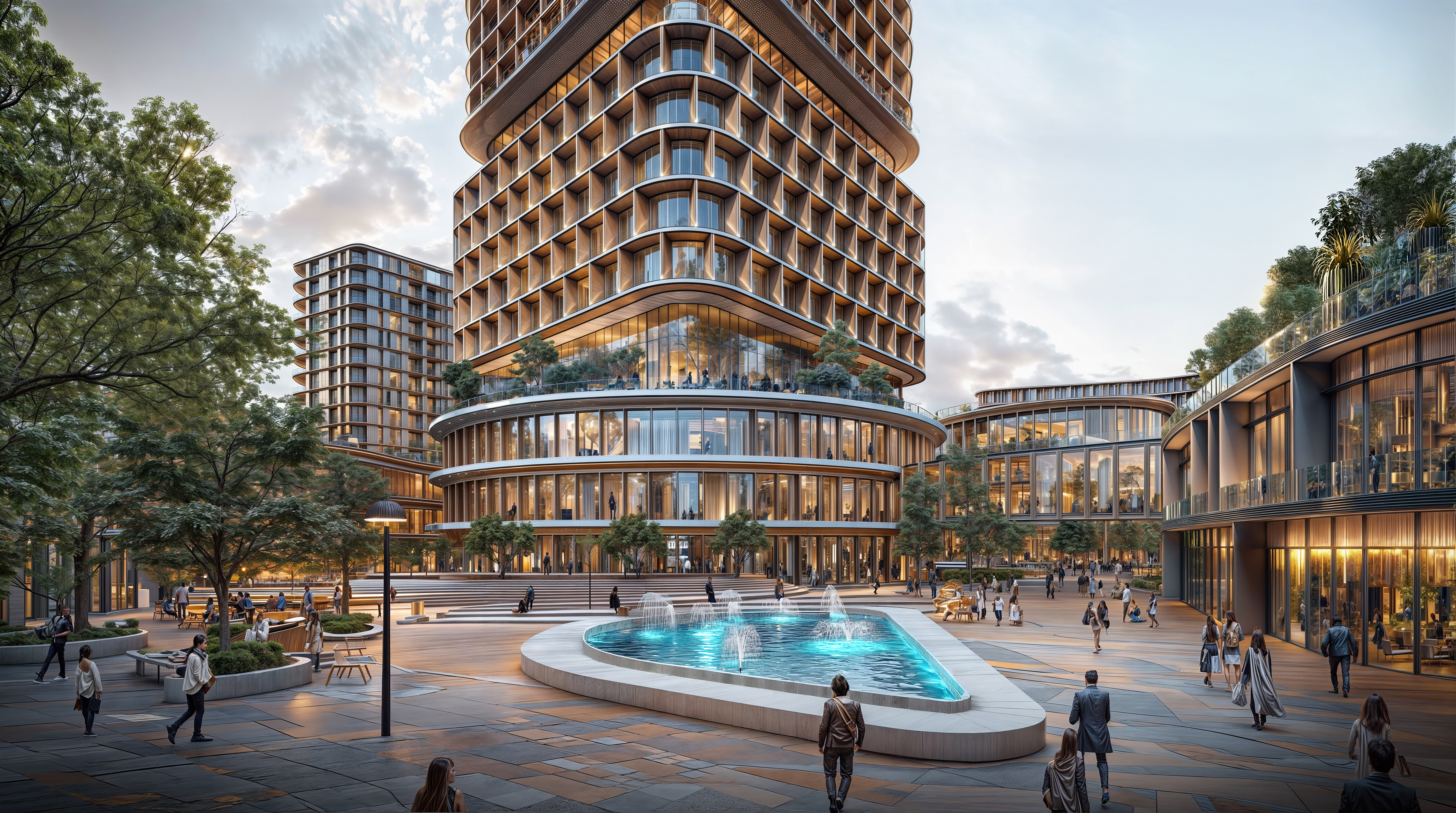
The surrounding landscape is not treated as a secondary layer but as an active generator of spatial quality. It extends from the building’s base outward, forming fluid transitions between public, semi-public, and private realms. Carefully orchestrated thresholds and green corridors blur the boundaries between indoor and outdoor environments, enriching both visual and physical connectivity.
At the ground level, commercial units are embedded within a richly textured landscape composed of native vegetation, porous paving, and shaded seating zones. These elements collectively form a multifunctional public ground that supports a variety of social interactions—from casual encounters to communal gatherings. Rather than serving as a mere transit zone, this level becomes a socially charged interface that invites urban life in.
The landscape strategy incorporates a balanced composition of soft and hard elements to facilitate both ecological performance and user comfort. Vegetated buffers, permeable surfaces, and microclimate-regulating features enhance the site’s environmental responsiveness, while simultaneously defining pedestrian flow and programmatic use.
Architecturally, the project balances verticality and horizontality through a material palette that resonates with the surrounding context. The façade’s tonal gradation and texture mirror the layered nature of the landscape below, reinforcing a consistent visual language across the development.
Ultimately, this project positions landscape as a primary design driver—one that informs circulation, defines atmosphere, and contributes to the cultural and ecological narrative of the site. By dissolving rigid boundaries between structure and ground, it offers a new typology for mixed-use development: one that is open, integrated, and attuned to the rhythms of everyday urban life.
Project Team
Sinem Kılıç, Nalan Korkut,Taner Doger
Project Status
Completed